Latest Posts

Showing posts with label Dystopia. Show all posts
On her nineteenth birthday, Princess Kelsea Raleigh Glynn, raised in exile, sets out on a perilous journey back to the castle of her birth to ascend her rightful throne. Plain and serious, a girl who loves books and learning, Kelsea bears little resemblance to her mother, the vain and frivolous Queen Elyssa. But though she may be inexperienced and sheltered, Kelsea is not defenseless: Around her neck hangs the Tearling sapphire, a jewel of immense magical power; and accompanying her is the Queen’s Guard, a cadre of brave knights led by the enigmatic and dedicated Lazarus. Kelsea will need them all to survive a cabal of enemies who will use every weapon—from crimson-caped assassins to the darkest blood magic—to prevent her from wearing the crown.
Despite her royal blood, Kelsea feels like nothing so much as an insecure girl, a child called upon to lead a people and a kingdom about which she knows almost nothing. But what she discovers in the capital will change everything, confronting her with horrors she never imagined. An act of singular daring will throw Kelsea’s kingdom into tumult, unleashing the vengeance of the tyrannical ruler of neighboring Mortmesne: the Red Queen, a sorceress possessed of the darkest magic. Now Kelsea will begin to discover whom among the servants, aristocracy, and her own guard she can trust.
But the quest to save her kingdom and meet her destiny has only just begun—a wondrous journey of self-discovery and a trial by fire that will make her a legend…if she can survive.
The Queen of the Tearling by Erika Johansen
Book One of The Queen of the Tearling Trilogy
High Fantasy/Dystopia

2 out of 5 Stars 
The rumored setting of The Queen of the Tearling was intriguing, though perhaps it should have been more of a red flag. Here we have a novel with a typical fantasy setting that takes inspiration from the Middle Ages... and yet it takes place in the future, presumably on Earth. For whatever reason, the British and the Americans made "the Crossing," and sailed to a new "continent" to reestablish society. Our setting is this new society, several generations later, though no advancements seem to have been made. Much knowledge was lost in the journey, and the Tear kingdom has been stalled on any sort of progress. A priest, at one point, comes across a book with a purple cover and remarks upon the color of the dye - apparently, in the many years they've existed on this continent, they've been unable to rediscover how to dye things purple. This gives you an idea of just how hopeless this setting is. Everyone seems to have knowledge of all that was lost in the Crossing, and yet no one seems inclined to try to regain that which was lost no matter how much they long for it.

Within this haphazardly constructed setting, we follow Kelsea Raleigh. Kelsea has been raised in isolation with two assigned guardians. Her mother was once Queen of the Tearling, and decided to send Kelsea away to grow up in safety until she was of age to inherit the throne. At the start of the novel, Kelsea is reclaimed from her secret home by the Queen's Guard and brought back to a kingdom she has never known and is fully expected to immediately become its ruler. Her mother died shortly after sending Kelsea away, and Kelsea's uncle has had the honorable position of Regent in the Queen’s absence. Greedy to keep his power, and gain the true power of a King, her Uncle hopes to kill her before she can ever come into her crown. Her journey to Queendom is filled with assassination attempts, and it seems that the Regent may not be the only one who wants her dead.

Kelsea, as a main character, is interesting. Too often in fiction a female character must be attractive, and female protagonists are quite often driven by romantic plot lines. Kelsea fits neither of those criteria. As a matter of fact, readers are repeatedly reminded that Kelsea is indeed "ugly" and overweight. She is constantly told by men that she isn't physically attractive enough for them. While I respect Johansen for allowing her protagonist to have her story without needing to be beautiful and loved by men, the story isn't all that interesting. Kelsea is a very introspective character, and both her characterization and the plot rely almost entirely on her reacting to injustice. The novel is filled with Kelsea's realization that things in her kingdom are absolutely awful, and her attempts to shoddily patch things up. If I'd been more drawn to her character, perhaps this would have been enough to sustain me. That unfortunately wasn’t the case.

Inevitably, I wasn't entirely satisfied with the characters, the setting was too aggravating to allow me full immersion into the world and the plot wasn't all that riveting. I would definitely say that this was a disappointment. I'd also like to add that this is a strange book to market - it has been labeled as YA by many readers and yet most consider it to be something "other". The coming-of-age elements of the story definitely give it a YA feel, but the content doesn't shy away from sex and violence. Regardless, I don't think everyone will feel as harshly about this as I did. This would probably fit best with readers who aren't as critical of world-building as I am and are looking for a unique female protagonist in a world where we seem to have "beautiful" and "romantically involved" on our checklist of things we must be. 

I received an eARC of The Queen of the Tearling in exchange for an honest review.

Veronica Roth’s Divergent trilogy (Divergent, Insurgent, Allegiant) has captured the hearts and thoughts of millions of readers. In Divergent Thinking, YA authors explore even more of Tris and Tobias’ world, including    • What Divergent’s factions have in common with one of psychology’s most prominent personality models • The biology of fear: where it comes from and how Tris and the other Dauntless are able to overcome it • Full-page maps locating all five faction headquarters and other series landmarks in today’s Chicago, based on clues from the books • Plus a whole lot more, from why we love identity shorthand like factions to Tris’ trouble with honesty to the importance of choice, family, and being brave.With a dozen smart, surprising, mind-expanding essays on all three books in the trilogy, Divergent Thinking provides a companion fit for even the most Erudite Divergent fan.

Divergent Thinking: YA Authors on Veronica Roth's Divergent Trilogy
Standalone Anthology/Companion to the Divergent Trilogy
Non-fiction

4 out of 5 stars
Warning: Divergent Thinking has spoilers for all three novels in the Divergent trilogy.

The Divergent Trilogy, for me, started strong and became progressively weaker. The world-building and the revelations of the final book that revealed how Chicago became what it was were both partially implausible and boring. YA Dystopian novels are great for two reasons - firstly, there tends to be a lot of action and a fast pace. The Divergent trilogy held up this end of the bargain for most of its run. Secondly, the world-building and/or themes allow for a more thought-provoking experience. The trilogy didn't deliver this for me. Divergent Thinking filled in most of what I felt the trilogy lacked, providing insights that allowed a deeper, more speculative look into the series and the Divergent world. For someone left so disillusioned and dissatisfied at the end of the trilogy, this was a perfect book to pick up.

Divergent Thinking contains a dozen essays written by an equal amount of YA authors. Each takes on a topic; from the pros and cons of the faction system to why Dauntless, as a military body, failed in its goals. As with most anthologies, some of the essays are stronger than others. My favorite of the collection was "Fear & The Dauntless Girl" by Blythe Woodston, which pleasantly surprised me. The essay looked at the biology of fear (in an interesting way! I promise it's not like reading a biology textbook) and what factors in Divergent's Chicago groomed its people for violence and rebellion. I found this to be the most insightful of the anthology, while still remaining readable and entertaining.

The main critique I have of Divergent Thinking is that some of the essays became a little repetitive. It didn't seem like there was any correspondence between the contributors, since so many of them wrote about ridiculously similar topics. The factions in particular seem to be a very popular topic, but it got old fast. The factions in Divergent were never anything I found incredibly thought provoking, and I had already made a lot of the connections the authors made in their essays... so these were slightly tedious to get through. The first two essays in the collection are both making comparisons between the factions and personality types. If the essays hadn't been put together, maybe it would have been a little less obvious and a little more bearable.

I think Divergent Thinking has something to offer every Divergent fan, even those of us who were left feeling unsatisfied with the trilogy's conclusion.

I was given a copy of this book by the publisher in exchange for an honest review.
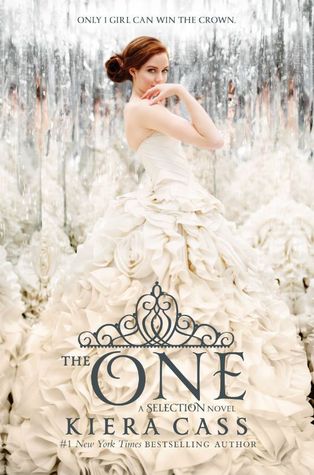
(Summary may contain spoilers if you haven't read the earlier books in the trilogy) The Selection changed America Singer's life in ways she never could have imagined. Since she entered the competition to become the next princess of IllĂ©a, America has struggled with her feelings for her first love, Aspen--and her growing attraction to Prince Maxon. Now she's made her choice . . . and she's prepared to fight for the future she wants.

The One by Kiera Cass
Third Book in The Selection Trilogy
YA/Romance/'Dystopia'

 1.5 out of 5 stars
he Selection Trilogy was never my favorite. They work well as quick, light-hearted (and weirdly addictive) reads, but don't offer much more than that. This is one of those trilogies that should have been a standalone. There isn't enough story to warrant three separate books! If you're reading this review, however, you've probably already invested in this series. I definitely recommend you read this if you've read the first two books, The Selection and The Elite, even if I didn't enjoy this final installment. It's worth at least knowing the conclusion, even if it is ridiculously predictable.

The majority of the issues I had with this book are identical to those I had with the first two books. While these books are labeled as dystopia, the dystopian elements are superficial in their influence on the story. We're given a caste system and some people who don't like it and boom! Dystopian qualification obtained. The world-building was lacking in favor of the petty conflicts faced by America and her two love interests, which may be fine for some, but left me unsatisfied. The relationships between the characters were equally as shallow as the world-building, but were given much more attention in all of the books. 

While I found the first two books to be somewhat fun, The One didn't live up to that. After awhile, the conflict caused by characters refusing to communicate properly over the span of multiple books, the laziness shown towards the world-building and towards the plot points developed surrounding the 'rebels' (which is not at all resolved, at least not in a satisfying or plausible way), and the out-of-character behavior shown by some of the main characters for the sake of adding drama to the story... The One was more aggravating than enjoyable.

Again, I still recommend this to those invested in the series, as a lot of readers really enjoyed this last installment. I just wasn't one of them.