Latest Posts

Showing posts with label Sci-fi. Show all posts
On a remote, icy planet, the soldier known as Breq is drawing closer to completing her quest. 
Once, she was the Justice of Toren -- a colossal starship with an artificial intelligence linking thousands of soldiers in the service of the Radch, the empire that conquered the galaxy. 
Now, an act of treachery has ripped it all away, leaving her with one fragile human body, unanswered questions, and a burning desire for vengeance.
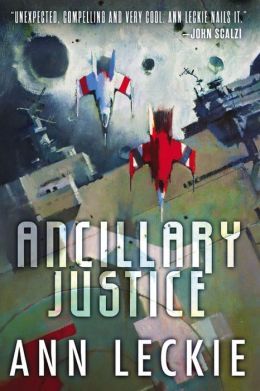
Ancillary Justice by Ann Leckie
Book One of the Imperial Radch Trilogy
Science Fiction/Space Opera

4 out of 5 stars

Ancillary Justice is a difficult book to get into. Had I not gone into this with the knowledge that many reviewers loved the book but still described it as 'confusing,' the beginning might have turned me off. The narrative relies upon a few key concepts, some of which may be hard to digest. With the start of the novel, Leckie has the responsibility of serving these concepts to readers in a timely manner without overwhelming them with exposition. How well she managed to pull this off will depend on the reader. While I found the introduction to the world to be effective, it was challenging to get through. Nonetheless, I wouldn't consider it a flaw as I can't conceive a better method than what Leckie chose. For anyone who is looking for an action-packed, thrilling space opera, this is not what you're looking for. Ancillary Justice is a challenge, on a variety of levels, and that challenge was most of the appeal for me.

The main challenge of Ancillary Justice relates to gender. Our main character, Breq, is an AI (artificial intelligence) who was created within the Radch empire. The Radchaai don't recognize gender. This isn't because there are no longer males and females, but the Radchaai don't put any importance in these differences and assign expectations on people based on their biological sex. With technological advancements allowing for an equal playing field for both sexes, gender is rendered irrelevant. As Ancillary Justice is written in English, and the Radchaai don't distinguish gender, we're left with Breq using a confusing pronoun system. Everyone that Breq meets, whether they are male or female, is referred to with a feminine pronoun. Breq often struggles to judge whether a person is male or female when visiting a gendered society, but even if she knows that someone is a male, she proceeds to use the feminine pronoun. The majority of readers will face some amount of confusion with this, and if you can't accept it early on in the book, the entirety of the narrative will be a struggle. Ancillary Justice is written in first person, with Breq's voice, and the non-discriminatory use of feminine pronouns is not something that goes away.

Breq's existence as an AI makes her difficult to empathize with, in theory. Her narration could be described as robotic and unfeeling, but I think it would be fallacious to say that Breq feels nothing. Even as an AI, Breq does have emotions. In fact, most of the conflicts in Ancillary Justice are caused by Breq's feelings. The narration doesn't need to indulge in dramatic internal monologues outlining every emotion that Breq experiences. We see her emotions through her actions, as her emotions are something that Breq cannot describe or control, or even realize until she's looking back at her actions after all is said and done. She is as much a slave to emotion as a human would be, which is something Leckie reveals slowly and effectively. That is what makes Breq such a compelling character, and is why I didn't struggle to empathize with her in the end.

Leckie's plotting was a bit chaotic. As I mentioned briefly at the start of this review, a good chunk of the beginning was focused on communicating the conceptual world-building - namely the Radchaai's stance on gender and the what/why/how's of the ancillary system. This is to be expected because this is not a standalone novel but a first novel in a trilogy. The beginning is not only the foundation for this book, but those that come after. Nonetheless, the start of Ancillary Justice is one that requires the reader to push through numerous chapters before we have any sort of thrilling plot or coherent world. The middle, on the other hand, is Ancillary Justice's strong point. The majority of the book features alternating chapters from different times - the 'main timeline' being the present where Breq is a lone ancillary seeking revenge, and the 'past timeline' that reveals how Breq was separated from her ship and her other ancillaries. The combination of these timelines does a wonderful job at raising suspense. When the two timelines become one, however, the book's pace slows. The middle is where it peaks, and all after that just seems to sag in comparison. The actual ending of this book is quite muted and opens more doors than it closes, which can be a bit of a disappointment when we spend the entire book leading up to this great act of revenge that Breq is desperately seeking. Regardless, I can't wait to read book two, Ancillary Sword, and see where Leckie takes this story next.

There are no heroes. Ten years ago, Calamity came. It was a burst in the sky that gave ordinary men and women extraordinary powers. The awed public started calling them Epics. But Epics are no friend of man. With incredible gifts came the desire to rule. And to rule man you must crush his wills. Nobody fights the Epics... nobody but the Reckoners. A shadowy group of ordinary humans, they spend their lives studying Epics, finding their weaknesses, and then assassinating them. And David wants in. He wants Steelheart—the Epic who is said to be invincible. The Epic who killed David's father. For years, like the Reckoners, David's been studying, and planning—and he has something they need. Not an object, but an experience.  He's seen Steelheart bleed. And he wants revenge.
Steelheart by Brandon Sanderson
First book in The Reckoners trilogy
Young Adult/Post-Apocalyptic/Superheroes

 5 out of 5 stars
I also have a video review for Steelheart, if you'd like to watch instead of read this review.

Steelheart reads like a novelization of an action film. This makes it a quick and entertaining read. The main character, David, is that (possibly archetypal) character who obsesses over a group or organization and finds himself trying to weasel his way into it. This organization is The Reckoners, the group which lends its name to the title of the series and obviously plays a pivotal role in the story. David and the Reckoners are quite possibly the only people to stand up to the Epics in this post-apocalyptic world. At least, the only people still alive.

The first-person narration from David's POV makes this a hilarious book. This provides a bit of "comic relief" from the heavier aspects of the novel. David has a thing for metaphors, even though he's absolutely terrible at coming up with them (and he knows it). Here's an example;
"Even a ninety-year-old blind priest would stop and stare at this woman. If he weren't blind, that is. 'Dumb metaphor,' I thought. 'I'll have to work on that one.' I have trouble with metaphors."
The characters were all introduced in an easily digestible way, but Sanderson does flesh them out more throughout the story. When we're introduced to a new character, they typically had a bold personality offsetting them from the rest so as to resist confusion about who's who. Everyone has layers and backstory revealed throughout the novel, however, so we don't stick with the more cookie-cutter personalities that were introduced to us. And, of course, there is always room for surprises about who some of these characters really are.

I was left with no complaints when I finished Steelheart. Everything came together perfectly at the end, and sets us on a mysterious and fascinating path for the next installment in the trilogy. Would highly recommend this to anyone who's looking for an action-packed book! 

Vicious by V.E. Schwab
Standalone, but a sequel is possible
Adult/Science Fiction/Super Heroes
Summary:
Victor and Eli started out as college roommates—brilliant, arrogant, lonely boys who recognized the same sharpness and ambition in each other. In their senior year, a shared research interest in adrenaline, near-death experiences, and seemingly supernatural events reveals an intriguing possibility: that under the right conditions, someone could develop extraordinary abilities. But when their thesis moves from the academic to the experimental, things go horribly wrong. 
Ten years later, Victor breaks out of prison, determined to catch up to his old friend (now foe), aided by a young girl whose reserved nature obscures a stunning ability. Meanwhile, Eli is on a mission to eradicate every other super-powered person that he can find—aside from his sidekick, an enigmatic woman with an unbreakable will. Armed with terrible power on both sides, driven by the memory of betrayal and loss, the archnemeses have set a course for revenge—but who will be left alive at the end?

On Goodreads | On Amazon | On Book Depository

 4 out of 5 stars
More like a 4.5, but let's just go with 4.

Finding righteousness where only evil truly lies. Working to a "happy ending" with a less-than-honorable set of methods. Morality that teeters only within a spectrum of grey, approaching black & white standards only when seen through the veil of a delusional mind. This is the core of what Vicious is - and where its appeal lies. There is no great act of goodness triumphing over evil. There is no clean-cut hero or villain. You're thrown into a tale bending to the hungers of two men - whether they desire revenge or righteousness - ultimately, their hungers leading to the other's demise. This is a story of two nemeses, who were once friends, and now want nothing more than to see the other dead.

Vicious is told in multiple POVs, in multiple time periods. We flip between the present, the near past, and the distant past. The back-story unfolds simultaneously with the present conflict. This works incredibly well. We are always given just enough information about the past as we need at any moment, and we're not only left curious about what is going to happen in the end, but what exactly happened 10 years ago that spurred all of this on. Towards the end, the multiple POVs felt more like a hindrance than a help - but I think this is a problem a lot of books have when attempting multiple POVs. The execution in the beginning and throughout most of the book was flawless, however.

The dynamics between the characters - specifically our two main characters, Eli and Victor, was phenomenal. Their relationship is incredibly fascinating and watching their friendship crumble into hatred is very entertaining. I was slightly disappointed with the characterization of Eli, if I'm being honest. In the beginning, he's an interesting and enigmatic character. He undergoes drastic changes to his personality (if you consider mentions of character development spoilery, skip the italics) and essentially becomes a religious fanatic - which felt strained and too reliant on tropes. While I mentioned the morality being very much grey, I still found it easy to relate to one of the main characters over the other. At first I thought it was perhaps because Victor is given more attention in the beginning, but it's mostly because crazy religious fanatics make me want to rip my eyes out. So no team Eli as an option for me. I would have liked if it had been harder to pick a side, since that was the main appeal for me.

My main complaints lie with parts of the book mostly leaning towards the end. Things began to feel generic, from Eli's characterization to certain fantasy elements in what powers various characters possessed. Some things felt like they needed more explanation or they felt too "convenient" for the story. Not huge issues, but they did put a damper on my enthusiasm. Ultimately I really enjoyed this book and would definitely recommend it!