Latest Posts

Showing posts with label Fantasy. Show all posts
I am tired of being used, hurt, and cast aside.
Adelina Amouteru is a survivor of the blood fever. A decade ago, the deadly illness swept through her nation. Most of the infected perished, while many of the children who survived were left with strange markings. Adelina’s black hair turned silver, her lashes went pale, and now she has only a jagged scar where her left eye once was. Her cruel father believes she is a malfetto, an abomination, ruining their family’s good name and standing in the way of their fortune. But some of the fever’s survivors are rumored to possess more than just scars—they are believed to have mysterious and powerful gifts, and though their identities remain secret, they have come to be called the Young Elites.
Teren Santoro works for the king. As Leader of the Inquisition Axis, it is his job to seek out the Young Elites, to destroy them before they destroy the nation. He believes the Young Elites to be dangerous and vengeful, but it’s Teren who may possess the darkest secret of all.
Enzo Valenciano is a member of the Dagger Society. This secret sect of Young Elites seeks out others like them before the Inquisition Axis can. But when the Daggers find Adelina, they discover someone with powers like they’ve never seen.Adelina wants to believe Enzo is on her side, and that Teren is the true enemy. But the lives of these three will collide in unexpected ways, as each fights a very different and personal battle. But of one thing they are all certain: Adelina has abilities that shouldn’t belong in this world. A vengeful blackness in her heart. And a desire to destroy all who dare to cross her. It is my turn to use. My turn to hurt.
 The Young Elites by Marie Lu
Book One of The Young Elites Trilogy
YA/Fantasy
2 out of 5 stars
The Young Elites was a book sold to me on one concept alone - the novel follows a villainous young woman coming into power. In an era where antiheroes are remarkably popular, Marie Lu serves us an unforgiving antiheroine. This is not your typical hero’s journey. This is a girl’s descent into a darkness that she may not be able to pull herself out of. Unfortunately, Lu starts the novel off at what may be an inopportune time. While the story is quick to start, a series of negative consequences are inflicted on the rest of The Young Elites. Jumping straight into the action means that we learn very little of our main character and the setting she’s living in. In terms of Adelina’s characterization, The Young Elites turns to sporadic but frequent flashbacks that begin to feel a lot like filler.

The world-building never seems to get on its feet at any point throughout the book, and the setting, inspired by Renaissance Italy, is only revealed to the reader in shallow terms. Even as the plot of the novel follows Adelina coming into her power, the magic system isn’t even properly explained. While the concepts that brought me to pick this up were there, they didn’t seem to expand into anything more than what was offered in the synopsis. The execution of this novel completely fell flat, which surprised me as Marie Lu already has an immensely popular trilogy under her belt. I couldn’t help but feel disappointed.

I feel obliged to mention that I’m grateful that Marie Lu has given us a main character that pulls away from our expectations of female characters. Female villains are not granted the same leniency in fiction as male villains in a time where dark fantasy is flourishing with villainous men at the forefront. I can definitely appreciate Lu pushing the limits put on female characters, regardless of whether or not she executed it well. The epilogue also shows that Lu hopes to push on even more boundaries and diversify her fiction, though she seems hesitant to do so. As much as I can appreciate authors trying to diversify their work, it doesn’t make up for a lackluster story.

While I found this to be disappointing, I do think a lot of readers will really enjoy The Young Elites. YA readers who aren’t as acclimated in the fantasy genre who are looking for a darker story about a young girl who isn’t a typical innocent protagonist will likely love The Young Elites. The fast-paced writing makes it a quick and easy read and would be perfect for YA readers looking to get into fantasy without too much commitment.

In the ancient city-state of Gujaareh, peace is the only law. Upon its rooftops and amongst the shadows of its cobbled streets wait the Gatherers - the keepers of this peace. Priests of the dream-goddess, their duty is to harvest the magic of the sleeping mind and use it to heal, soothe . . . and kill those judged corrupt.
But when a conspiracy blooms within Gujaareh's great temple, Ehiru - the most famous of the city's Gatherers - must question everything he knows. Someone, or something, is murdering dreamers in the goddess' name, stalking its prey both in Gujaareh's alleys and the realm of dreams. Ehiru must now protect the woman he was sent to kill - or watch the city be devoured by war and forbidden magic.

The Killing Moon by N.K. Jemisin
Book One of the Dreamblood Duology
Fantasy
4.5 out of 5 stars

The strength of The Killing Moon is its sense of perspective. Every element of this book, from the setting Jemisin has so carefully constructed to the characters populating the story, is offered to the reader through various perspectives. The city of Gujaareh and its culture are not just shown in the light of its inhabitants, but also in the eyes of neighboring cities - both in the present day perspective and how it has been viewed historically. Each character is fleshed out through their interactions with other characters. The development of all of the characters, not just our main characters, has a sense of realism in how they are allowed to be as paradoxical and unpredictable as real people tend to be. 

There is a moral complexity within The Killing Moon that sets it apart from most books I've read. This complexity is all a part of this idea of varied perspectives. Is Ehiru, one of our main characters, a murderer or a merciful priest? There is no clean-cut sense of right or wrong through the eyes of our main characters. Jemisin presents an array of moral choices, all seemingly valid, and leaves it up to the reader to decide where they fall on the spectrum. Even our villain is given a shot at reader sympathy through Jemisin's masterful sense of perspective. 

But this sense of perspective has its downfalls. The beginning is perhaps harder to wade through than some readers may be willing to put up with, though readers of epic fantasy should be accustomed to this sort of thing. As stated before, both the world and the characters of The Killing Moon are fully fleshed out through various perspectives and this takes time. The city of Gujaareh isn't a setting we've seen recycled over and over through the history of the fantasy genre, as many worlds grow from a fascination with medieval Europe. Gujaareh has some Ancient Egyptian inspiration that shines through, but Jemisin pulls inspiration from other historical settings as well. This means the setting may require a little more brainpower to get into. As long as you stick with it, however, this book is incredibly rewarding. Once grounded in this story, it’s hard to put the book down until you've devoured it.

Amidst Jemisin’s gorgeous prose, The Killing Moon perfectly balances the action, political struggles and the religious aspects central throughout. None of these elements overpower the others, if anything they add more depth to one another. Each relates to the main themes stretched throughout - power, corruption, love… all things inextricably tied with the political and religious struggles fueling the plot. The Killing Moon is, in the end, a beautiful yet sad story of humanity. I can definitely see myself picking this up again in the future, as the messages laid throughout are so heartbreakingly true and this is a story that would benefit from more than one reading. If you're looking for a morally complex and diverse fantasy that touches on deep topics we're all familiar with, I'd highly recommend picking up The Killing Moon.
An epic fantasy in the tradition of Game of Thrones, Sovereign is set in a world which once knew gods, demons, and magic, and to which all three are returning. New York Times bestseller Chris Roberson joins artist Paul Maybury to tell the story of masked undertakers facing the undead with swords, of civil wars and cultures in collision, and of ancient threats emerging from the ashes of history to menace the future.  

Sovereign Volume 1 by Chris Roberson and Paul Maybury
Collects Sovereign #1-5, plus extras.
Graphic Novel/Fantasy

3 out of 5 stars
At a time of a Convergence - an event that strengthens the power of the magic-bearers in this world and the daemons of the Unreal - the survival of the world is put into question as a society of Horselords begins to realize their tradition of burying their dead will now bring forth an undead army hell-bent on taking over. In Sovereign, we follow a multitude of characters and watch as old traditions seemingly long forgotten come back to the forefront and new magic is birthed from the strength of the Convergence. 

As is typical of collections such as this, Sovereign doesn't quite offer an entire plotline. Sovereign Volume 1's main goal is to introduce the world and its characters, and it does so well enough. While I did enjoy this, I'm not sure it was enough to pull me into this series. The constant changing of POV characters felt a bit distracting in the end, as the 5 installments collected in this graphic novel are not enough to fully connect to any of the characters since we don't have a true focus on any of them. I'm a fan of multiple POVs in epic fantasy, but I'm not quite sure that it works as well in comic form. Even in novel form, it takes extra time to get into a story with multiple POVs, and when you're dealing with comics the time between releases can be a bit jarring.

For avid readers of comics, perhaps this would interest you more. The world that Roberson and Maybury have created is very interesting and has a lot of potential. The potential could have been a bit higher if I'd not found the art style to be so lackluster, as the settings and cultures presented are unique but the art left much to be desired. I would also have liked to have seen the magic systems fleshed out a bit more, as they were the most interesting, but most neglected, aspect of the world Sovereign lets us into. All in all, it was entertaining but not quite enough to make the wait between volumes worth it.


I was provided an eARC through NetGalley in exchange for an honest review.

On her nineteenth birthday, Princess Kelsea Raleigh Glynn, raised in exile, sets out on a perilous journey back to the castle of her birth to ascend her rightful throne. Plain and serious, a girl who loves books and learning, Kelsea bears little resemblance to her mother, the vain and frivolous Queen Elyssa. But though she may be inexperienced and sheltered, Kelsea is not defenseless: Around her neck hangs the Tearling sapphire, a jewel of immense magical power; and accompanying her is the Queen’s Guard, a cadre of brave knights led by the enigmatic and dedicated Lazarus. Kelsea will need them all to survive a cabal of enemies who will use every weapon—from crimson-caped assassins to the darkest blood magic—to prevent her from wearing the crown.
Despite her royal blood, Kelsea feels like nothing so much as an insecure girl, a child called upon to lead a people and a kingdom about which she knows almost nothing. But what she discovers in the capital will change everything, confronting her with horrors she never imagined. An act of singular daring will throw Kelsea’s kingdom into tumult, unleashing the vengeance of the tyrannical ruler of neighboring Mortmesne: the Red Queen, a sorceress possessed of the darkest magic. Now Kelsea will begin to discover whom among the servants, aristocracy, and her own guard she can trust.
But the quest to save her kingdom and meet her destiny has only just begun—a wondrous journey of self-discovery and a trial by fire that will make her a legend…if she can survive.
The Queen of the Tearling by Erika Johansen
Book One of The Queen of the Tearling Trilogy
High Fantasy/Dystopia

2 out of 5 Stars 
The rumored setting of The Queen of the Tearling was intriguing, though perhaps it should have been more of a red flag. Here we have a novel with a typical fantasy setting that takes inspiration from the Middle Ages... and yet it takes place in the future, presumably on Earth. For whatever reason, the British and the Americans made "the Crossing," and sailed to a new "continent" to reestablish society. Our setting is this new society, several generations later, though no advancements seem to have been made. Much knowledge was lost in the journey, and the Tear kingdom has been stalled on any sort of progress. A priest, at one point, comes across a book with a purple cover and remarks upon the color of the dye - apparently, in the many years they've existed on this continent, they've been unable to rediscover how to dye things purple. This gives you an idea of just how hopeless this setting is. Everyone seems to have knowledge of all that was lost in the Crossing, and yet no one seems inclined to try to regain that which was lost no matter how much they long for it.

Within this haphazardly constructed setting, we follow Kelsea Raleigh. Kelsea has been raised in isolation with two assigned guardians. Her mother was once Queen of the Tearling, and decided to send Kelsea away to grow up in safety until she was of age to inherit the throne. At the start of the novel, Kelsea is reclaimed from her secret home by the Queen's Guard and brought back to a kingdom she has never known and is fully expected to immediately become its ruler. Her mother died shortly after sending Kelsea away, and Kelsea's uncle has had the honorable position of Regent in the Queen’s absence. Greedy to keep his power, and gain the true power of a King, her Uncle hopes to kill her before she can ever come into her crown. Her journey to Queendom is filled with assassination attempts, and it seems that the Regent may not be the only one who wants her dead.

Kelsea, as a main character, is interesting. Too often in fiction a female character must be attractive, and female protagonists are quite often driven by romantic plot lines. Kelsea fits neither of those criteria. As a matter of fact, readers are repeatedly reminded that Kelsea is indeed "ugly" and overweight. She is constantly told by men that she isn't physically attractive enough for them. While I respect Johansen for allowing her protagonist to have her story without needing to be beautiful and loved by men, the story isn't all that interesting. Kelsea is a very introspective character, and both her characterization and the plot rely almost entirely on her reacting to injustice. The novel is filled with Kelsea's realization that things in her kingdom are absolutely awful, and her attempts to shoddily patch things up. If I'd been more drawn to her character, perhaps this would have been enough to sustain me. That unfortunately wasn’t the case.

Inevitably, I wasn't entirely satisfied with the characters, the setting was too aggravating to allow me full immersion into the world and the plot wasn't all that riveting. I would definitely say that this was a disappointment. I'd also like to add that this is a strange book to market - it has been labeled as YA by many readers and yet most consider it to be something "other". The coming-of-age elements of the story definitely give it a YA feel, but the content doesn't shy away from sex and violence. Regardless, I don't think everyone will feel as harshly about this as I did. This would probably fit best with readers who aren't as critical of world-building as I am and are looking for a unique female protagonist in a world where we seem to have "beautiful" and "romantically involved" on our checklist of things we must be. 

I received an eARC of The Queen of the Tearling in exchange for an honest review.

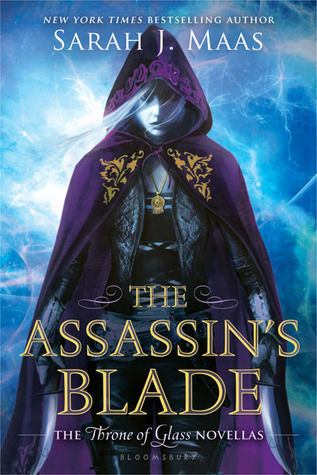
Celaena Sardothien is Adarlan's most feared assassin. As part of the Assassin's Guild, her allegiance is to her master, Arobynn Hamel, yet Celaena listens to no one and trusts only her fellow killer-for-hire, Sam. In these action-packed novellas - together in one edition for the first time - Celaena embarks on five daring missions. They take her from remote islands to hostile deserts, where she fights to liberate slaves and seeks to avenge the tyrannous. But she is acting against Arobynn's orders and could suffer an unimaginable punishment for such treachery. Will Celaena ever be truly free? Explore the dark underworld of this kick-ass heroine to find out.

The Assassin's Blade by Sarah J. Maas
Prequel Novellas 1-5 of the Throne of Glass series
YA/High Fantasy

3.5 out of 5 Stars
Novellas have become the new thing in YA fiction in the past few years.With the torturous waiting period readers are forced to endure between new books in a series, short stories featuring our favorite characters are generally appreciated. The Assassin's Blade, as a collection, sets itself apart from other such novellas. With five novellas in all, originally released individually in e-book form, The Assassin's Blade has an overarching story that takes up as many pages as any other book in the series. Combined, the novellas of The Assassin's Blade make up a novel on its own, while still being able to (mostly) stand on their own as novellas.

While this is a prequel to the Throne of Glass series, it was published after the second book in the series, Crown of Midnight, and it's best to read the series in order of publication. There's certainly nothing wrong with reading this before the other books in the series, but I think some of the events in The Assassin's Blade will make more sense once readers have come to some discoveries about Celaena's character in Crown of Midnight. For readers of the series who weren't the biggest fan of Throne of Glass, I wouldn't recommend picking up The Assassin's Blade. The ending of The Assassin's Blade can be guessed by anyone who has read Throne of Glass, and there isn't much added to the series as this isn't meant to be a compulsory read one needs to pick up to continue on with the series. The novellas are mostly fun adventure stories.

The Assassin's Blade shows the progress Maas has made as a writer. One of the main problems with Throne of Glass is Celaena's characterization. We get told a lot about how Celaena is such an awesome, badass assassin but we don't really see that shown in her actions. The Assassin's Blade almost seems like its entire purpose is fleshing out her character, while telling an action-packed story in the process. For fans of the Throne of Glass series, this is a great read to save for when you're waiting for the next installment in the series to be published... but it's not at all necessary to read. Overall this was an exciting installment and I'll be interested to see if some of the characters from these novellas show up in later books in the series!

In a society steeped in tradition, Princess Lia’s life follows a preordained course. As First Daughter, she is expected to have the revered gift of sight—but she doesn’t—and she knows her parents are perpetrating a sham when they arrange her marriage to secure an alliance with a neighboring kingdom—to a prince she has never met.
On the morning of her wedding, Lia flees to a distant village. She settles into a new life, hopeful when two mysterious and handsome strangers arrive—and unaware that one is the jilted prince and the other an assassin sent to kill her. Deception abounds, and Lia finds herself on the brink of unlocking perilous secrets—even as she finds herself falling in love.

The Kiss of Deception by Mary E. Pearson
First book in The Remnant Chronicles
YA/High Fantasy/Romance


  3 out of 5 stars
The title of The Kiss of Deception felt as much a description of the book's contents as it was a description of my experience reading it. The beginning hints at an interesting world with an intriguing mythology and mystery that is, inevitably, ignored for the sake of putting romance at the forefront. What little we are given of the culture of this world was enough to keep me wanting more, but it didn't pay off in the end. Whatever remnants of the mystery we're given is dedicated to adding flare to the love triangle. How to make a love triangle not seem like every other YA love triangle? Make the two men involved have ambiguous identities and keep readers guessing about who's who! While some readers have found this 'mystery' to be a riveting aspect of the story, I was more annoyed than impressed. Spending more than half a book not knowing which character is which for the sake of an attempt at suspense was not my cup of tea.

The best that The Kiss of Deception had to offer was the writing style. I found myself wanting to highlight certain passages as I think this is a fairly "quotable" and beautifully written story. The writing wasn't perfect - I found it to be lacking in description of the world - but it was my favorite aspect of the story. While the language of this was up to par for me, I wish the contents were equal in value. 

I think The Kiss of Deception is a decent foundation for the rest of the series, but it didn't leave me wanting to continue. After reading through 400+ pages and getting denied anything besides an uncompelling romance and being left with a ridiculous cliffhanger that offers no resolution, I felt like The Kiss of Deception dedicated too much of my time to a meandering story that wasn't worth it in the end. For readers who enjoy romance with a weak fantasy backdrop, this is the book for you. For any reader wanting more than just a fantasy backdrop, I'd say avoid The Kiss of Deception. At least until more books come out in the series, which could improve upon the foundation this provided... but only time will tell.
A prince with a quest. A commoner with mysterious powers. And dragons that demand to be freed—at any cost. 
Prince Corin has been chosen to free the dragons from their bondage to the Empire, but dragons aren’t big on directions. They have given him some of their power, but none of their knowledge. No one, not the dragons nor their riders, is even sure what keeps the dragons in the Empire’s control. Tam, sensible daughter of a well-respected doctor, had no idea before she arrived in the capital that she is a Seer, gifted with visions. When the two run into each other (quite literally) in the library, sparks fly and Corin impulsively asks Tam to dinner. But it’s not all happily ever after. Never mind that the prince isn’t allowed to marry a commoner: war is coming to Caithen. Torn between Corin’s quest to free the dragons and his duty to his country, the lovers must both figure out how to master their powers in order to save Caithen. With a little help from a village of secret wizards and a rogue dragonrider, they just might pull it off.
Moth and Spark by Anne Leonard
Standalone
Adult/Fantasy/Romance

 2 out of 5 stars


Moth and Spark was unfortunately a case of a book not living up to the expectations set by the synopsis. While the synopsis prioritizes a fantastical conflict between a prince and the dragons he is sworn to free, the book itself prioritizes romance. The beginning of the novel is promising, but as soon as the two lovers discover each other the plot and the intriguing (albeit familiar) world become non-existent. Leonard starts the book with the building of the story's foundation - one with mystery and magic, but this quickly fizzled out into a story incapable of holding my attention.

Unable to decide what kind of story it wants to be, Moth and Spark ultimately does poorly on all fronts. There is a mystery too easily solved. A romance that accelerated too quickly and persisted throughout the story to provide some attempt at a "forbidden lovers" conflict that wasn't really a conflict, considering there wasn't much forbidden about the relationship. The dragons and the magic took a backseat for most of the novel, and when they did get incorporated into the story, they felt too familiar and unoriginal. Had all of these aspects been fleshed out and better woven together, Moth and Spark could have been a more enjoyable read.

I can only recommend this on the grounds that you go into Moth and Spark aware that the book is mostly a romance, and a simplistic one at that. If you're here for the dragons and political intrigue, I'd say this isn't your best bet. It took me months of struggling with this book to finally finish it, which doesn't seem uncommon based on the reception from other reviewers.

There are several scenes with sexual content, so younger readers should be aware of that.


I won an ARC copy of Moth and Spark in a Goodreads giveaway.

One thousand years after a great conflict known as The Mapmaker’s War, a daughter is born to an ambitious historian and a gifted translator. Secret Riven doesn’t speak until her seventh year but can mysteriously communicate with plants and animals. Unsettled by visions and dreams since childhood, she tries to hide her strangeness, especially from her mercurial father and cold mother. Yet gentle, watchful Secret finds acceptance from Prince Nikolas, her best friend, and Old Woman, who lives in the distant woods.
When Secret is twelve, her mother receives an arcane manuscript to translate from an anonymous owner. Zavet suffers from nightmares and withdraws into herself. Secret sickens with a fever and awakens able to speak an ancient language, one her mother knows as well. Suddenly, Zavet dies. The manuscript is missing, but a cipher has been left for Secret to find.
Years later, Secret becomes a translator’s apprentice for Fewmany, an influential magnate, who has taken an interest in her for reasons she cannot discern. Before Secret learns why, Old Woman confronts Secret with the truth of her destiny—a choice she must make that is tied to an ancient past.
The Chronicle of Secret Riven by Ronlyn Domingue
Second book in The Keeper of Tales Trilogy
Sequel to The Mapmaker's War
Fantasy
 3 out of 5 stars

The Chronicle of Secret Riven is a slightly disconnected sequel to The Mapmaker's War, which I have also reviewed and really enjoyed. This sequel takes place in the same world, but thousands of years after the first book. As such, there are many cultural shifts that have taken place and new characters to be introduced. This book and the following book are set up to be more of a duology, with The Mapmaker's War being a prequel set in the distant past and the final two books following the same character's story. While The Mapmaker's War easily stands on it's own, The Chronicle of Secret Riven cannot stand apart from its coming sequel without feeling incomplete. You do not need to read The Mapmaker's War to read The Chronicle of Secret Riven, but I would recommend that you do. It adds a layer to the story that those who haven't read the first book will miss.

A lot of what I loved about The Mapmaker's War was missing in The Chronicle of Secret Riven. Whereas I highly enjoyed the unique writing style - the fact that the first book was written in second person narration - this second installment went for a more conventional style. The fact that the second installment not only follows different characters in a completely changed future-world, and the vast change in writing style, creates a massive disconnect between the two books. While Domingue still showcases her ability to create enthralling characters for a massively character-driven fantasy story, that felt like the only element of the story that remained similar to its predecessor.

Our main character, Secret, was an interesting one to follow. In this installment, we see her grow from a mute child, discriminated against for her disability and for her race (she is a person of color), to a young woman applying to University. This gives the book a more Young Adult feel. Even though I loved Secret, I felt we saw too much of her. This book is twice as long as its predecessor, and unnecessarily so. We recount every year of her life in too much detail, which developed more of her characterization than any the plot. While Domingue's books are driven by the characters more-so than the story, we could have known just as much about Secret in less words rather than recounting every situation in which she is bullied by other kids or her mother gets angry at her (which happens a lot).

The development of the world that we originally see in The Mapmaker's War was intriguing. There are interlude chapters, short and written in a style more reminiscent on the first book, that lay out the setting clearly for the reader. While I found the setting to be interesting, and the additions of new technologies to add a different element unseen in the first novel, these interlude chapters felt unneeded. I ended up skimming them for the most part, because I felt the visuals and information provided were already sufficiently supplied in the normal chapters. The interlude chapters were more confusing than helpful, since I was never quite sure why they were needed.

The Chronicle of Secret Riven, in the end, could have used significant trimming and perhaps stopped a little further into Secret's tale. The end of the book didn't feel like an end at all, and nothing was really accomplished aside from Secret growing up and coming into her powers. Mysteries that were alluded to remain unsolved. The story remains unfinished, despite the fact that it clocks in at 400 pages and has more than enough space to wrap up more plot-lines than it attempted to.

I am still looking forward to the next book, since the mysteries hinted at in this installment were quite interesting and I would love to see where this goes... I just wish this book had provided more.


I was provided a review copy by the publisher in exchange for an honest review.

This will be the map of your heart, old woman. In an ancient time, in a faraway land, a young woman named Aoife is allowed a rare apprenticeship to become her kingdom’s mapmaker, tasked with charting the entire domain. Traveling beyond its borders, she finds a secretive people who live in peace, among great wealth. They claim to protect a mythic treasure, one connected to the creation of the world. When Aoife reports their existence to her kingdom, the community is targeted as a threat. Attempting to warn them of imminent danger, Aoife is exiled for treason and finds refuge among the very people who had been declared her enemy. With them, she begins a new life surrounded by kindness, equality, and cooperation. But within herself, Aoife has no peace. She cannot share the grief she feels for the home and children she left behind. She cannot bear the warrior scars of the man she comes to love. And when she gives birth to their gifted daughter, Aoife cannot avoid what the child forces her to confront about her past and its truth. On this most important of journeys, there is no map to guide her. In this tale—her autobiography— Aoife reveals her pain and joy, and ultimately her transformation. 
The Mapmaker's War by Ronlyn Domingue
First book in The Keeper of Tales Trilogy
Fantasy
 4.5 out of 5 stars
Rounded up to 5 on Goodreads. 

There are books that take risks and pay for it with polarizing reviews. The Mapmaker’s War is one of those books, but luckily, I was one of those who really enjoyed it. Set up as an autobiography as a woman living in an ancient kingdom, we follow the life of an aspiring mapmaker and the war that comes about as a result of her ambitions. This review will mostly be concerned with the elements of this book that I considered risky, so that you can go into this with a better guess of whether or not this book is for you. 

Seeing as this is meant to be a memoir of sorts, The Mapmaker’s War is character-driven rather than plot-driven. The ending it more of a fizzling out than a big bang, since most people’s lives tend to calm down towards the end… especially if they have the time to be settling down and writing a book about their life. The conflict is largely internal, and the ending reveals no big twist or battle scene. Anyone who goes into this thinking they need to trudge through the first half to reach some imagined action-packed second half are making a mistake.

Being written in an unconventional style, namely the fact that it’s written in second person rather than the more commonly used first or third person, this may be hard to get into for some. This writing style made for an intimate reading experience in my case. I know readers used to a more common style will be put off, and if you can’t get used to it by the third chapter, you’ve probably got very little hope of adjusting to the book.

Gender, specifically what it means to be a woman, is a big theme in this book. Domingue seems to manage a feminist flavor in all of her books (There is one I’ve yet to read, but even the synopsis reveals the feminist spin), and The Mapmaker’s War in particular deals with some sensitive topics, i.e. reproductive rights. Those interested in either feminism or gender studies will probably get more out of what this novel has to offer.

The characterization in The Mapmaker’s War reflects the story as a whole. This is a mix of history and mythology, of ‘reality’ and fairytales. This is true of the characters as well, in a way. Our cast of characters contains individuals that are archetypal but real. While they are inspired by archetypes, they don’t come off as cardboard cutouts at any point in the story.

Overall, I loved this book and couldn't put it down. Would recommend to those willing to try something new!


Since birth, Nyx has been betrothed to the evil ruler of her kingdom-all because of a foolish bargain struck by her father. And since birth, she has been in training to kill him.With no choice but to fulfill her duty, Nyx resents her family for never trying to save her and hates herself for wanting to escape her fate. Still, on her seventeenth birthday, Nyx abandons everything she's ever known to marry the all-powerful, immortal Ignifex. Her plan? Seduce him, destroy his enchanted castle, and break the nine-hundred-year-old curse he put on her people. But Ignifex is not at all what Nyx expected. The strangely charming lord beguiles her, and his castle-a shifting maze of magical rooms-enthralls her.As Nyx searches for a way to free her homeland by uncovering Ignifex's secrets, she finds herself unwillingly drawn to him. Even if she could bring herself to love her sworn enemy, how can she refuse her duty to kill him? With time running out, Nyx must decide what is more important: the future of her kingdom, or the man she was never supposed to love.
Cruel Beauty by Rosamund Hodge
Standalone novel
YA/Retelling/Fantasy

 4 out of 5 stars
Cruel Beauty is one of the books that are incredibly hard to thoroughly review without being spoilery, so I'll have to leave some points alone for the purpose of not ruining the book for those who haven't read it.

Cruel Beauty takes place in the most unique world that I've read in YA fiction, and possibly in fiction in general. This is both a strength and a weakness for the story, and the way it will be received depends entirely upon the reader. A lot of readers go into this expecting a Beauty and the Beast retelling, and there is much more to it than that. The additional inspiration for the plot and the world-building is drawn from numerous sources and, as such, may be confusing or jarring for some readers. While the aspects of retelling are not confusing (where we reference Beauty and the Beast, Rumpelstiltskin, Bluebeard...) as you don't need to understand or recognize the source to know what's going on, the world-building is largely built on information that is not common knowledge and may be hard to digest for readers unfamiliar with the source material. 

The world and magic system is built upon two major things: Greek mythology and Hermeticism. The world itself seems to be an alternate version of a Greco-Roman world, and works as if hundreds of years ago, something happened that made it differ from what we would see today. This world is cut off from the rest of the Earth and isolated, and the gods of Greek mythology are part of the traditional belief system. While I'm not the most knowledgeable of Greek mythology, I did think Hodge did a decent job of explaining what everything meant while incorporating it into the story. I'm not sure I think the handling of Hermeticism was as good, however. I'm familiar with Hermeticism and the Hermetic principles as they stand in our reality, and Hodge uses Hermeticism as a magical system. There are a lot of principles just outright said but not explained to the reader, and while I understood what was going on, I think it might be more than some readers can handle. A lot of readers seem to not know that Hermeticism is something that actually exists, and those who are unfamiliar with it may be confused by it. I would say that readers will get the most out of Cruel Beauty if they have some understanding of Hermeticism or Greek mythology, otherwise the amount of world-building may seem daunting and confusing. 

The plot drifted enough from the original story that I didn't feel like everything was completely predictable, as I've found with some retellings. It wasn't entirely unpredictable however. There was what I think was an intended plot twist that I saw coming in the beginning, but as it was something that I was hoping would happen, I didn't mind the predictability. (It was a bit of a relief to see I was right, actually.) The best part of Cruel Beauty, for me, was the romance. The chemistry between Nyx and her love interest was to die for. I think some readers may be troubled by the romance in the beginning, for reasons I cannot explain because of spoilers, but all I will say is hang in there before giving up on it.

In the end, Cruel Beauty is dark, strange and beautiful. I would recommend it to those willing to spend a bit of time wading into a bizarre other world, and ready to read through lots of romancy bits.
Not every fairytale has a happy ending. This is the story of a princess who became a villain. As Princess of Wonderland Palace and the future Queen of Hearts, Dinah’s days are an endless monotony of tea, tarts, and a stream of vicious humiliations at the hands of her father, the King of Hearts. The only highlight of her days is visiting Wardley, her childhood best friend, the future Knave of Hearts — and the love of her life.When an enchanting stranger arrives at the Palace, Dinah watches as everything she’s ever wanted threatens to crumble. As her coronation date approaches, a series of suspicious and bloody events suggests that something sinister stirs in the whimsical halls of Wonderland. It’s up to Dinah to unravel the mysteries that lurk both inside and under the Palace before she loses her own head to a clever and faceless foe.
Queen of Hearts by Colleen Oakes
First book in a trilogy (?)
Young Adult/Retelling/Fantasy 

 2 out of 5 stars

Queen of Hearts is an Alice in Wonderland retelling that feels very distant from the original source material. Alice in Wonderland is a delightful and nonsensical read, while Queen of Hearts is incredibly dark. It's also strange to see the Queen of Hearts given back-story, because she was a ridiculous character in the original text. I love stories that flesh out villians (like Wicked did for the Wizard of Oz's villain, the Wicked Witch) but I think the Queen of Hearts is not the best villain to receive this kind of attention. Oakes did do a decent job of pulling it off though, despite my reluctance in believing that it could be done.

I believe this is meant to be the first book in a trilogy, and unfortunately I felt that this is one of those series that should have been a standalone. Queen of Hearts is around 200 pages, so it's not very long in itself, and the novel stops just when it starts getting exciting. There wasn't enough story in this installment, in my opinion, to warrant a single novel. I also felt that the writing was excessive at times, with description in particular, so a lot of those 200 or so pages felt like they had a lot of 'filler' material.

Dinah, our main character, I unfortunately didn't like. I felt that there was this massive attempt by the author to make me like her, but it didn't work. The King, Dinah's father, is also purely evil which is always boring. The King had no depth and seemed to only exist to make Dinah miserable and force readers to pity her. It felt contrived, so it didn't make me feel very bad for Dinah at all because it felt unrealistic. Dinah herself is a rather mean character, and while she becomes idealistically nicer throughout the book, I wasn't a fan of her. She felt rather villainous to begin with, so the idea that she is some innocent princess who becomes a villainous queen feels false.

The other characters borrowed from the original Alice in Wonderland include the Mad Hatter, who is Dinah's insane younger brother. The Cheshire Cat, who's actually a man, a very powerful and menacing man, who is rumored to be able to shape-shift into a cat. The White Rabbit, who serves as Dinah's tutor and mentor. I was slightly uncomfortable with the way that all of the characters seem to be in the royal family or involved in the royal affairs, and I felt like the most interesting characters got the least amount of attention in the plot.

The world-building was probably my favorite aspect of Queen of Hearts. From the ever-changing constellations in the Wonderland night sky to the menacing and enigmatic Black Towers that begin to haunt Dinah's dreams. It definitely retains the ridiculousness of the world-building from Alice in Wonderland. Snow is pink. Why? Because it's Wonderland.

Ultimately this was an interesting concept that I felt could have been executed better.

I was provided an eARC in exchange for an honest review.


There are no heroes. Ten years ago, Calamity came. It was a burst in the sky that gave ordinary men and women extraordinary powers. The awed public started calling them Epics. But Epics are no friend of man. With incredible gifts came the desire to rule. And to rule man you must crush his wills. Nobody fights the Epics... nobody but the Reckoners. A shadowy group of ordinary humans, they spend their lives studying Epics, finding their weaknesses, and then assassinating them. And David wants in. He wants Steelheart—the Epic who is said to be invincible. The Epic who killed David's father. For years, like the Reckoners, David's been studying, and planning—and he has something they need. Not an object, but an experience.  He's seen Steelheart bleed. And he wants revenge.
Steelheart by Brandon Sanderson
First book in The Reckoners trilogy
Young Adult/Post-Apocalyptic/Superheroes

 5 out of 5 stars
I also have a video review for Steelheart, if you'd like to watch instead of read this review.

Steelheart reads like a novelization of an action film. This makes it a quick and entertaining read. The main character, David, is that (possibly archetypal) character who obsesses over a group or organization and finds himself trying to weasel his way into it. This organization is The Reckoners, the group which lends its name to the title of the series and obviously plays a pivotal role in the story. David and the Reckoners are quite possibly the only people to stand up to the Epics in this post-apocalyptic world. At least, the only people still alive.

The first-person narration from David's POV makes this a hilarious book. This provides a bit of "comic relief" from the heavier aspects of the novel. David has a thing for metaphors, even though he's absolutely terrible at coming up with them (and he knows it). Here's an example;
"Even a ninety-year-old blind priest would stop and stare at this woman. If he weren't blind, that is. 'Dumb metaphor,' I thought. 'I'll have to work on that one.' I have trouble with metaphors."
The characters were all introduced in an easily digestible way, but Sanderson does flesh them out more throughout the story. When we're introduced to a new character, they typically had a bold personality offsetting them from the rest so as to resist confusion about who's who. Everyone has layers and backstory revealed throughout the novel, however, so we don't stick with the more cookie-cutter personalities that were introduced to us. And, of course, there is always room for surprises about who some of these characters really are.

I was left with no complaints when I finished Steelheart. Everything came together perfectly at the end, and sets us on a mysterious and fascinating path for the next installment in the trilogy. Would highly recommend this to anyone who's looking for an action-packed book! 

Vicious by V.E. Schwab
Standalone, but a sequel is possible
Adult/Science Fiction/Super Heroes
Summary:
Victor and Eli started out as college roommates—brilliant, arrogant, lonely boys who recognized the same sharpness and ambition in each other. In their senior year, a shared research interest in adrenaline, near-death experiences, and seemingly supernatural events reveals an intriguing possibility: that under the right conditions, someone could develop extraordinary abilities. But when their thesis moves from the academic to the experimental, things go horribly wrong. 
Ten years later, Victor breaks out of prison, determined to catch up to his old friend (now foe), aided by a young girl whose reserved nature obscures a stunning ability. Meanwhile, Eli is on a mission to eradicate every other super-powered person that he can find—aside from his sidekick, an enigmatic woman with an unbreakable will. Armed with terrible power on both sides, driven by the memory of betrayal and loss, the archnemeses have set a course for revenge—but who will be left alive at the end?

On Goodreads | On Amazon | On Book Depository

 4 out of 5 stars
More like a 4.5, but let's just go with 4.

Finding righteousness where only evil truly lies. Working to a "happy ending" with a less-than-honorable set of methods. Morality that teeters only within a spectrum of grey, approaching black & white standards only when seen through the veil of a delusional mind. This is the core of what Vicious is - and where its appeal lies. There is no great act of goodness triumphing over evil. There is no clean-cut hero or villain. You're thrown into a tale bending to the hungers of two men - whether they desire revenge or righteousness - ultimately, their hungers leading to the other's demise. This is a story of two nemeses, who were once friends, and now want nothing more than to see the other dead.

Vicious is told in multiple POVs, in multiple time periods. We flip between the present, the near past, and the distant past. The back-story unfolds simultaneously with the present conflict. This works incredibly well. We are always given just enough information about the past as we need at any moment, and we're not only left curious about what is going to happen in the end, but what exactly happened 10 years ago that spurred all of this on. Towards the end, the multiple POVs felt more like a hindrance than a help - but I think this is a problem a lot of books have when attempting multiple POVs. The execution in the beginning and throughout most of the book was flawless, however.

The dynamics between the characters - specifically our two main characters, Eli and Victor, was phenomenal. Their relationship is incredibly fascinating and watching their friendship crumble into hatred is very entertaining. I was slightly disappointed with the characterization of Eli, if I'm being honest. In the beginning, he's an interesting and enigmatic character. He undergoes drastic changes to his personality (if you consider mentions of character development spoilery, skip the italics) and essentially becomes a religious fanatic - which felt strained and too reliant on tropes. While I mentioned the morality being very much grey, I still found it easy to relate to one of the main characters over the other. At first I thought it was perhaps because Victor is given more attention in the beginning, but it's mostly because crazy religious fanatics make me want to rip my eyes out. So no team Eli as an option for me. I would have liked if it had been harder to pick a side, since that was the main appeal for me.

My main complaints lie with parts of the book mostly leaning towards the end. Things began to feel generic, from Eli's characterization to certain fantasy elements in what powers various characters possessed. Some things felt like they needed more explanation or they felt too "convenient" for the story. Not huge issues, but they did put a damper on my enthusiasm. Ultimately I really enjoyed this book and would definitely recommend it!

The Diviners by Libba Bray
Book 1 of the Diviners series
YA/Historical Fiction/Paranormal/Mystery
Summary:
Evie O'Neill has been exiled from her boring old hometown and shipped off to the bustling streets of New York City--and she is pos-i-toot-ly thrilled. New York is the city of speakeasies, shopping, and movie palaces! Soon enough, Evie is running with glamorous Ziegfield girls and rakish pickpockets. The only catch is Evie has to live with her Uncle Will, curator of The Museum of American Folklore, Superstition, and the Occult--also known as "The Museum of the Creepy Crawlies."   
When a rash of occult-based murders comes to light, Evie and her uncle are right in the thick of the investigation. And through it all, Evie has a secret: a mysterious power that could help catch the killer--if he doesn't catch her first.

 On Goodreads | On Amazon | On Book Depository

5 out of 5 Stars 

The Diviners was a unique reading experience. I've been reading quite a lot of painfully formulaic YA books lately, and this was the exact opposite. This was intricately plotted, original in its structure and filled with a cast of realistic and likable characters. Reading The Diviners was like watching one long film that kept me in its grip for days and days. When I finished, I was exhausted, relieved and sad that the experience had ended.

I'm convinced that Libba Bray has a time machine and spends her nights in NYC during the Roaring Twenties. The world-building (part research, part invention) was stitched into every page with great care. The dialogue may come off as a little too much for some, as it's built on many old-fashioned expressions like "the cat's pajamas," and "chin music." Even though the novel is filled with these expressions that people of our age are unfamiliar with, Bray makes it easy to pick up on the meanings without being too obvious about it.

The execution of The Diviners was phenomenal. I'd say that the writing is honestly just really done well, and that's not really debatable. But what really surprised me with this was the effect these words had. While I have a (sometimes obnoxiously present) imagination, this book was much more visual than most I've read. It wasn't a fast read. There were at least a dozen times where I had to set a book down at the end of a scene or chapter because I was still caught in its grip. I wouldn't be able to move on because the images put into my head by Bray were so strong and fascinating, that they had to be dealt with and thoroughly cherished before moving on to the next.

I will warn you, however, that this visual experience comes with a price. While our central character, Evie, is rather superficial and likes to get drunk and party, there are very dark scenes in this book. This is a book about murder, and not murders of the merciful kind. You will witness brutal deaths. I was haunted by scenes and had trouble sleeping one night after reading. I don't scare easy, but this had me spooked. If you have a weak stomach and low tolerance for violent images, I'd say The Diviners may not be the book for you.

With the wide cast of main characters, there was bound to be romance in The Diviners. And there was. Luckily this wasn't done in an archetypal way. Typically in YA relationships are either unrealistically grown at a fast pace or strained by a love triangle. While I think these elements linger ever so slightly in the background of some of the romantic interactions in The Diviners, it's still done well and in a more original way.

While at times this book could have used condensing, that's really the only complaint I have - and for me it's very minor. The Diviners has weaseled its way onto my favorites shelf.

This is a review I wrote last year, when I first read The Diviners.


The Demon King by Cinda Williams Chima
Book 1 of the Seven Realms series
YA/High Fantasy
Summary:
One day Han Alister catches three young wizards setting fire to the sacred mountain of Hanalea. Han takes an amulet away from Micah Bayar, son of the High Wizard, to ensure the boy won’t use it against him. The amulet once belonged to the Demon King, who nearly destroyed the world a millennium ago. With a magical piece so powerful at stake, Han knows that the Bayars will stop at nothing to get it back.

Meanwhile, Princess Raisa ana’Marianna has her own battle to fight. She’s just returned to court after three years of riding and hunting with her father’s family. Raisa aspires to be like Hanalea, the legendary warrior queen who killed the Demon King and saved the world. But it seems that her mother has other plans for her—plans that include a suitor who goes against everything the Queendom stands for.


5 out of 5 Stars 
I've also done a video review, if you'd like to watch & listen instead of read.

 This was a book that came highly recommended by numerous people who insisted that I would adore this series. They were right, at least, in as much as I can judge from only reading (and loving) the first installment of the quartet. Before even finishing the book, I was worried about what I would say in my review... because I couldn't think of anything to really complain about. Everything had a natural greatness, which is something that will end up being repeated in various ways throughout my review. Ultimately, I had no complaints - unless you count my need to continue on with the series... now.

The cast of characters in The Demon King was perfectly done for a fantasy novel. In some fantasy series we have an overwhelming amount of characters. This can cause confusion for a lot of readers, and is one of the reasons some book-lovers avoid the genre altogether. In YA fantasy, however, I have often experienced the opposite of this - the amount of characters is underwhelming. We end up focusing on the main character, maybe two dudes from a love triangle, and perhaps an evil king or something of that ilk. Neither of these problems relate at all to The Demon King. There was never a character whose name and purpose I'd forgotten, or who seemed extraneous in the overall plot. Several people were pivotal to the plot, even if in small ways, and they were allowed to be more than just flat, background characters. 

The world-building also felt presented in a similar way. There wasn't any information dumped on the reader that you weren't made to anticipate - clawing your way through the pages to figure out this missing piece of information on the world and how the characters & the plot fit in with it. Because of the multiple POVs, we also get to see locations and cultures through slightly different lenses. While the world wasn't anything ridiculously original, it was easy to sink into and intriguing to learn about. The intertwining of world history and the plot unfolding in The Demon King was endlessly interesting.

In terms of plot, this wasn't an entirely predictable novel. I didn't really know where the story would climax or have much of a solid guess of what was going to happen in the end, which is a plus for me. I struggle with the predictability of a lot of other books, and this one didn't give all of its secrets away too early. This is, of course, aided by the fact that this is the first book in a series, and some plot points will inevitably bleed into the sequels, but nonetheless it was a nice experience. Things felt wrapped up at the end, but there was also a sense of a new beginning - one in which readers will have to wait until the next installment to fully explore its path. 

As I said, I really enjoyed this novel. There are only so many ways to profess my love before I descend into bumbling-fangirl status.