Latest Posts

Showing posts with label Adult. Show all posts
In the ancient city-state of Gujaareh, peace is the only law. Upon its rooftops and amongst the shadows of its cobbled streets wait the Gatherers - the keepers of this peace. Priests of the dream-goddess, their duty is to harvest the magic of the sleeping mind and use it to heal, soothe . . . and kill those judged corrupt.
But when a conspiracy blooms within Gujaareh's great temple, Ehiru - the most famous of the city's Gatherers - must question everything he knows. Someone, or something, is murdering dreamers in the goddess' name, stalking its prey both in Gujaareh's alleys and the realm of dreams. Ehiru must now protect the woman he was sent to kill - or watch the city be devoured by war and forbidden magic.

The Killing Moon by N.K. Jemisin
Book One of the Dreamblood Duology
Fantasy
4.5 out of 5 stars

The strength of The Killing Moon is its sense of perspective. Every element of this book, from the setting Jemisin has so carefully constructed to the characters populating the story, is offered to the reader through various perspectives. The city of Gujaareh and its culture are not just shown in the light of its inhabitants, but also in the eyes of neighboring cities - both in the present day perspective and how it has been viewed historically. Each character is fleshed out through their interactions with other characters. The development of all of the characters, not just our main characters, has a sense of realism in how they are allowed to be as paradoxical and unpredictable as real people tend to be. 

There is a moral complexity within The Killing Moon that sets it apart from most books I've read. This complexity is all a part of this idea of varied perspectives. Is Ehiru, one of our main characters, a murderer or a merciful priest? There is no clean-cut sense of right or wrong through the eyes of our main characters. Jemisin presents an array of moral choices, all seemingly valid, and leaves it up to the reader to decide where they fall on the spectrum. Even our villain is given a shot at reader sympathy through Jemisin's masterful sense of perspective. 

But this sense of perspective has its downfalls. The beginning is perhaps harder to wade through than some readers may be willing to put up with, though readers of epic fantasy should be accustomed to this sort of thing. As stated before, both the world and the characters of The Killing Moon are fully fleshed out through various perspectives and this takes time. The city of Gujaareh isn't a setting we've seen recycled over and over through the history of the fantasy genre, as many worlds grow from a fascination with medieval Europe. Gujaareh has some Ancient Egyptian inspiration that shines through, but Jemisin pulls inspiration from other historical settings as well. This means the setting may require a little more brainpower to get into. As long as you stick with it, however, this book is incredibly rewarding. Once grounded in this story, it’s hard to put the book down until you've devoured it.

Amidst Jemisin’s gorgeous prose, The Killing Moon perfectly balances the action, political struggles and the religious aspects central throughout. None of these elements overpower the others, if anything they add more depth to one another. Each relates to the main themes stretched throughout - power, corruption, love… all things inextricably tied with the political and religious struggles fueling the plot. The Killing Moon is, in the end, a beautiful yet sad story of humanity. I can definitely see myself picking this up again in the future, as the messages laid throughout are so heartbreakingly true and this is a story that would benefit from more than one reading. If you're looking for a morally complex and diverse fantasy that touches on deep topics we're all familiar with, I'd highly recommend picking up The Killing Moon.
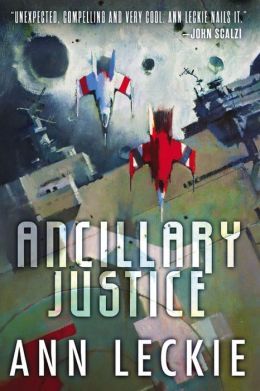
On a remote, icy planet, the soldier known as Breq is drawing closer to completing her quest. 
Once, she was the Justice of Toren -- a colossal starship with an artificial intelligence linking thousands of soldiers in the service of the Radch, the empire that conquered the galaxy. 
Now, an act of treachery has ripped it all away, leaving her with one fragile human body, unanswered questions, and a burning desire for vengeance.
Ancillary Justice by Ann Leckie
Book One of the Imperial Radch Trilogy
Science Fiction/Space Opera

4 out of 5 stars

Ancillary Justice is a difficult book to get into. Had I not gone into this with the knowledge that many reviewers loved the book but still described it as 'confusing,' the beginning might have turned me off. The narrative relies upon a few key concepts, some of which may be hard to digest. With the start of the novel, Leckie has the responsibility of serving these concepts to readers in a timely manner without overwhelming them with exposition. How well she managed to pull this off will depend on the reader. While I found the introduction to the world to be effective, it was challenging to get through. Nonetheless, I wouldn't consider it a flaw as I can't conceive a better method than what Leckie chose. For anyone who is looking for an action-packed, thrilling space opera, this is not what you're looking for. Ancillary Justice is a challenge, on a variety of levels, and that challenge was most of the appeal for me.

The main challenge of Ancillary Justice relates to gender. Our main character, Breq, is an AI (artificial intelligence) who was created within the Radch empire. The Radchaai don't recognize gender. This isn't because there are no longer males and females, but the Radchaai don't put any importance in these differences and assign expectations on people based on their biological sex. With technological advancements allowing for an equal playing field for both sexes, gender is rendered irrelevant. As Ancillary Justice is written in English, and the Radchaai don't distinguish gender, we're left with Breq using a confusing pronoun system. Everyone that Breq meets, whether they are male or female, is referred to with a feminine pronoun. Breq often struggles to judge whether a person is male or female when visiting a gendered society, but even if she knows that someone is a male, she proceeds to use the feminine pronoun. The majority of readers will face some amount of confusion with this, and if you can't accept it early on in the book, the entirety of the narrative will be a struggle. Ancillary Justice is written in first person, with Breq's voice, and the non-discriminatory use of feminine pronouns is not something that goes away.

Breq's existence as an AI makes her difficult to empathize with, in theory. Her narration could be described as robotic and unfeeling, but I think it would be fallacious to say that Breq feels nothing. Even as an AI, Breq does have emotions. In fact, most of the conflicts in Ancillary Justice are caused by Breq's feelings. The narration doesn't need to indulge in dramatic internal monologues outlining every emotion that Breq experiences. We see her emotions through her actions, as her emotions are something that Breq cannot describe or control, or even realize until she's looking back at her actions after all is said and done. She is as much a slave to emotion as a human would be, which is something Leckie reveals slowly and effectively. That is what makes Breq such a compelling character, and is why I didn't struggle to empathize with her in the end.

Leckie's plotting was a bit chaotic. As I mentioned briefly at the start of this review, a good chunk of the beginning was focused on communicating the conceptual world-building - namely the Radchaai's stance on gender and the what/why/how's of the ancillary system. This is to be expected because this is not a standalone novel but a first novel in a trilogy. The beginning is not only the foundation for this book, but those that come after. Nonetheless, the start of Ancillary Justice is one that requires the reader to push through numerous chapters before we have any sort of thrilling plot or coherent world. The middle, on the other hand, is Ancillary Justice's strong point. The majority of the book features alternating chapters from different times - the 'main timeline' being the present where Breq is a lone ancillary seeking revenge, and the 'past timeline' that reveals how Breq was separated from her ship and her other ancillaries. The combination of these timelines does a wonderful job at raising suspense. When the two timelines become one, however, the book's pace slows. The middle is where it peaks, and all after that just seems to sag in comparison. The actual ending of this book is quite muted and opens more doors than it closes, which can be a bit of a disappointment when we spend the entire book leading up to this great act of revenge that Breq is desperately seeking. Regardless, I can't wait to read book two, Ancillary Sword, and see where Leckie takes this story next.
A prince with a quest. A commoner with mysterious powers. And dragons that demand to be freed—at any cost. 
Prince Corin has been chosen to free the dragons from their bondage to the Empire, but dragons aren’t big on directions. They have given him some of their power, but none of their knowledge. No one, not the dragons nor their riders, is even sure what keeps the dragons in the Empire’s control. Tam, sensible daughter of a well-respected doctor, had no idea before she arrived in the capital that she is a Seer, gifted with visions. When the two run into each other (quite literally) in the library, sparks fly and Corin impulsively asks Tam to dinner. But it’s not all happily ever after. Never mind that the prince isn’t allowed to marry a commoner: war is coming to Caithen. Torn between Corin’s quest to free the dragons and his duty to his country, the lovers must both figure out how to master their powers in order to save Caithen. With a little help from a village of secret wizards and a rogue dragonrider, they just might pull it off.
Moth and Spark by Anne Leonard
Standalone
Adult/Fantasy/Romance

 2 out of 5 stars


Moth and Spark was unfortunately a case of a book not living up to the expectations set by the synopsis. While the synopsis prioritizes a fantastical conflict between a prince and the dragons he is sworn to free, the book itself prioritizes romance. The beginning of the novel is promising, but as soon as the two lovers discover each other the plot and the intriguing (albeit familiar) world become non-existent. Leonard starts the book with the building of the story's foundation - one with mystery and magic, but this quickly fizzled out into a story incapable of holding my attention.

Unable to decide what kind of story it wants to be, Moth and Spark ultimately does poorly on all fronts. There is a mystery too easily solved. A romance that accelerated too quickly and persisted throughout the story to provide some attempt at a "forbidden lovers" conflict that wasn't really a conflict, considering there wasn't much forbidden about the relationship. The dragons and the magic took a backseat for most of the novel, and when they did get incorporated into the story, they felt too familiar and unoriginal. Had all of these aspects been fleshed out and better woven together, Moth and Spark could have been a more enjoyable read.

I can only recommend this on the grounds that you go into Moth and Spark aware that the book is mostly a romance, and a simplistic one at that. If you're here for the dragons and political intrigue, I'd say this isn't your best bet. It took me months of struggling with this book to finally finish it, which doesn't seem uncommon based on the reception from other reviewers.

There are several scenes with sexual content, so younger readers should be aware of that.


I won an ARC copy of Moth and Spark in a Goodreads giveaway.

Vicious by V.E. Schwab
Standalone, but a sequel is possible
Adult/Science Fiction/Super Heroes
Summary:
Victor and Eli started out as college roommates—brilliant, arrogant, lonely boys who recognized the same sharpness and ambition in each other. In their senior year, a shared research interest in adrenaline, near-death experiences, and seemingly supernatural events reveals an intriguing possibility: that under the right conditions, someone could develop extraordinary abilities. But when their thesis moves from the academic to the experimental, things go horribly wrong. 
Ten years later, Victor breaks out of prison, determined to catch up to his old friend (now foe), aided by a young girl whose reserved nature obscures a stunning ability. Meanwhile, Eli is on a mission to eradicate every other super-powered person that he can find—aside from his sidekick, an enigmatic woman with an unbreakable will. Armed with terrible power on both sides, driven by the memory of betrayal and loss, the archnemeses have set a course for revenge—but who will be left alive at the end?

On Goodreads | On Amazon | On Book Depository

 4 out of 5 stars
More like a 4.5, but let's just go with 4.

Finding righteousness where only evil truly lies. Working to a "happy ending" with a less-than-honorable set of methods. Morality that teeters only within a spectrum of grey, approaching black & white standards only when seen through the veil of a delusional mind. This is the core of what Vicious is - and where its appeal lies. There is no great act of goodness triumphing over evil. There is no clean-cut hero or villain. You're thrown into a tale bending to the hungers of two men - whether they desire revenge or righteousness - ultimately, their hungers leading to the other's demise. This is a story of two nemeses, who were once friends, and now want nothing more than to see the other dead.

Vicious is told in multiple POVs, in multiple time periods. We flip between the present, the near past, and the distant past. The back-story unfolds simultaneously with the present conflict. This works incredibly well. We are always given just enough information about the past as we need at any moment, and we're not only left curious about what is going to happen in the end, but what exactly happened 10 years ago that spurred all of this on. Towards the end, the multiple POVs felt more like a hindrance than a help - but I think this is a problem a lot of books have when attempting multiple POVs. The execution in the beginning and throughout most of the book was flawless, however.

The dynamics between the characters - specifically our two main characters, Eli and Victor, was phenomenal. Their relationship is incredibly fascinating and watching their friendship crumble into hatred is very entertaining. I was slightly disappointed with the characterization of Eli, if I'm being honest. In the beginning, he's an interesting and enigmatic character. He undergoes drastic changes to his personality (if you consider mentions of character development spoilery, skip the italics) and essentially becomes a religious fanatic - which felt strained and too reliant on tropes. While I mentioned the morality being very much grey, I still found it easy to relate to one of the main characters over the other. At first I thought it was perhaps because Victor is given more attention in the beginning, but it's mostly because crazy religious fanatics make me want to rip my eyes out. So no team Eli as an option for me. I would have liked if it had been harder to pick a side, since that was the main appeal for me.

My main complaints lie with parts of the book mostly leaning towards the end. Things began to feel generic, from Eli's characterization to certain fantasy elements in what powers various characters possessed. Some things felt like they needed more explanation or they felt too "convenient" for the story. Not huge issues, but they did put a damper on my enthusiasm. Ultimately I really enjoyed this book and would definitely recommend it!